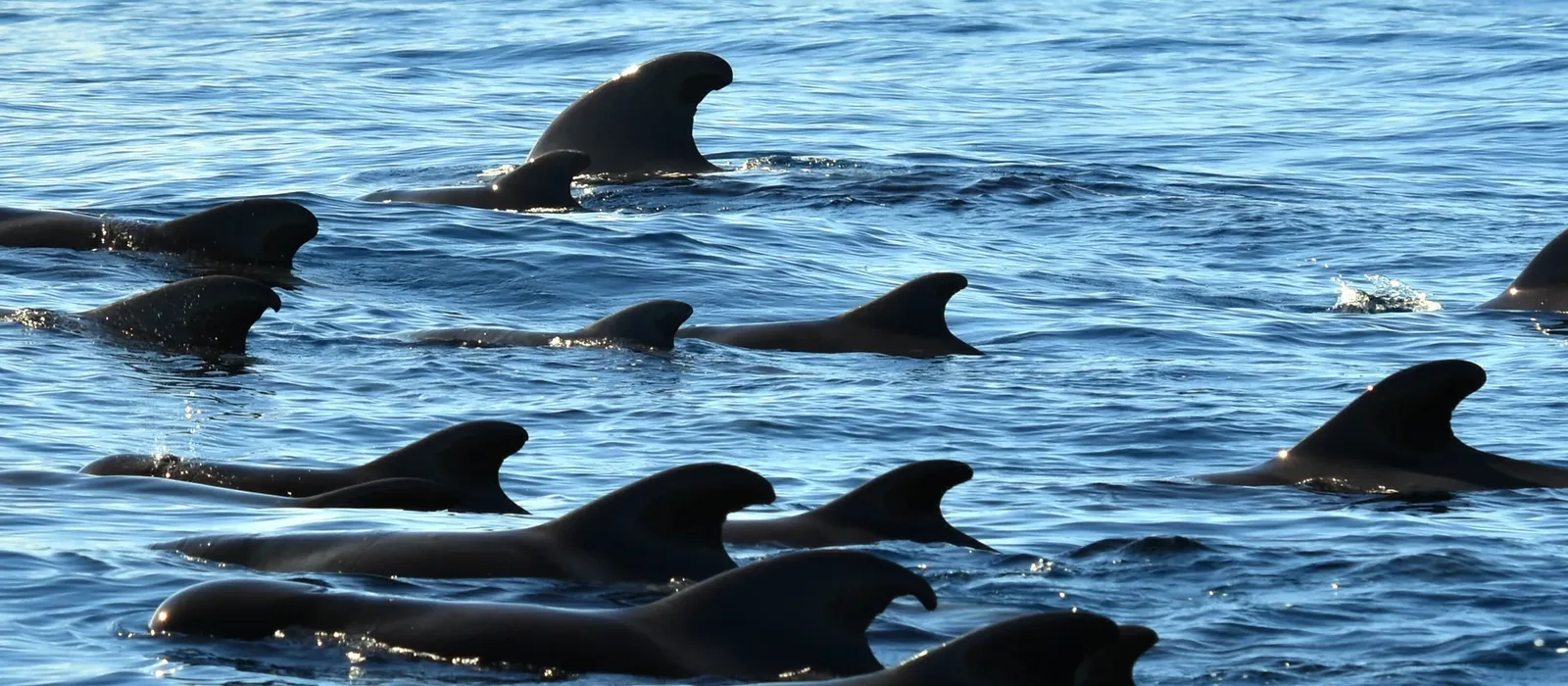
What photo-identification is
Photo-identification is a scientific technique for recognising each cetacean by its natural marks. Every animal’s dorsal fin has distinct notches, cuts and scars. They are like a fingerprint: no two are the same.
The method is simple and respectful. Photographs of the fins are taken outing after outing and compared with one another. In this way, who is who is identified without needing to touch or tag any animal.
How we use it in the Strip
A stable population of tropical pilot whales resides in the Teno-Rasca Marine Strip. Thanks to photo-identification, we follow those families over time without disturbing them.
This turns each outing into more than a trip. We often recognise individuals we have already seen before. It is not just any pilot whale: it is an old acquaintance of these waters.
Everything is done from the boat, at a distance, sailing slowly and without chasing. The photography does not unsettle the animals. It is the perfect way to learn from them while respecting their calm.
Why it matters
Recognising each individual helps us understand how these families live: who keeps company with whom, how they change over time, which areas they frequent. That knowledge is the basis of responsible marine tourism.
The better we know the animals, the better we can care for them. Knowing that specific individuals live in these waters, each with its own story, makes us treat them with even more respect.
For us, photo-identification brings together science and love for the sea. Each photo adds a little to the story of the Strip, and it reminds us that the sea is not a stage but the home of beings we learn to know by name. Sharing that knowledge with the people who sail with us is also part of the journey: when someone understands that this fin belongs to a particular animal, they look at the sea in a different way.