What it is like and how it lives
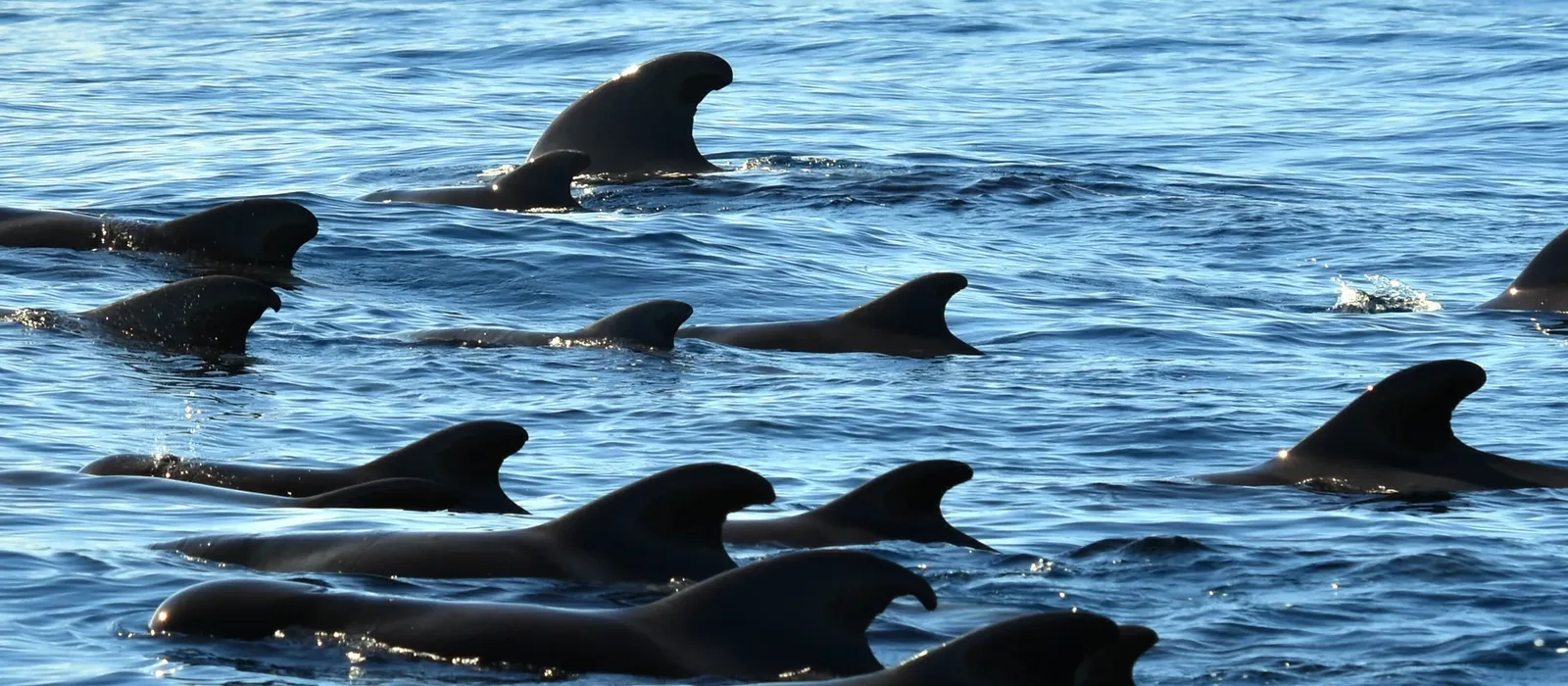
The tropical pilot whale has a thick body and a bulky head, rounded at the front. Its colour is very dark, almost black, with a lighter patch on the chest. Although it looks like a small whale, it belongs to the dolphin family.
It lives in close-knit family groups. Mothers, calves and other relatives move together, rest together and help one another. It feeds mainly on squid, which it hunts in deep water. That is why it spends part of the day submerged and part resting at the surface.
Where you experience it on board
A stable population of this species resides in the Teno-Rasca Marine Strip. It is the one we come across most often on our outings. Even so, the sea is not a stage and we never promise an encounter: nature alone decides.
When a group appears, we approach slowly and without chasing it. We sail at under four knots near the cetaceans, as the rules require. The silence of sailing helps: with no engine noise, the animals feel at ease, and sometimes it is they who come closer.
We often see them floating still at the surface, taking a breath before another dive. It is a serene sight, best enjoyed in calm and in a low voice.
A family we recognise
Every pilot whale has its own dorsal fin, with distinct notches, cuts and scars. They are like a fingerprint. Thanks to photo-identification, outing after outing we recognise the same individuals and follow their families without disturbing them.
This turns each encounter into something close. We do not see just any pilot whale: very often we see an old acquaintance of these waters. That bond is also a way of caring for the sea, because understanding who lives here helps us respect it better. Outing after outing, the families we recognise become part of the story of these waters, and sharing that story with the people sailing on board is one of the things we love most about this work.